Tuesday, March 16, 2021

Semester 2 Project: Compiling Hob Stories

In order to get a better idea of what these folk tales detail about Hobs such as characteristics and appearance; it also helps me plan out what tale to base my game off so I can start researching and writing a design document, a brief and then progress to creating concept art. 

Hob Stories:

The Hob of Hobthrush Hall 


The folktale about a Hob in Over Stilton, North Yorkshire; not too far from the village, deep in the North Yorkshire moors the Hob lived in the scarrs, a cliffside cave known as Hobthrush Hall, the Hob would visit the village and was a faithful servant to a man who kept the village inn. 


It was Hob's invariable practice to churn the cream during the night, which was prepared for him the evening before, for which his reward was a large slice of bread and butter, always placed ready for him when the family retired to bed, and always gone in the morning. 


One night, the cream was put into the churn as usual, but no bread and butter placed beside it. The Hob was so disgusted by ingratitude, that he never returned to the inn or the village. 


"In the precipitous cliffs, a short distance north-west of the village, called 'the Scarrs,' is a cave in the rock, known by the name of Hobthrush Hall, which was formerly the abode of a goblin of somewhat remarkable character, who appears by the stories yet current relating to him, to have been possessed of great agility, as he was in the habit of jumping from the hills above his dwelling to the top of Carlhow Hill, about half a mile distant. He was not of the malignant kind. On the contrary he was one of those friendly to man. The Silton goblin was a true and faithful servant to a person named Weighall, who kept the village inn, and rented the land on which his hall was situate. It was Hob's invariable practice to churn the cream during the night, which was prepared for him the evening before, for which his reward was a large slice of bread and butter, always placed ready for him when the family retired to bed, and always gone in the morning. One night, the cream was put into the churn as usual, but no bread and butter placed beside it. Hob was so disgusted with this piece of base ingratitude, that he never came to churn more, and appears to have entirely left the neighbourhood. His dwelling yet remains, a rugged cave among the rocks, dark, wet, and uncomfortable, but extending a considerable distance underground."


The book this tale is mentioned in is :- The Vale of Mowbray: a historical and topographical account of Thirsk and its neighbourhood by William Grainge, published in 1859


The Hob of Runswick Bay


Folk tale about a Hob in Runswick Bay; it is believed that the cliffs along the coast of the beach have small caves that were believed to be inhabited by a Hob - thus the caves have been known as ‘Hob Holes’. 


To locals of the fishing village the Hob was helpful to people in need of healing; the fishermen’s wives would carry their children to Hob Holes to cure them from the whooping cough by reciting this rhyme Hob Hole Hob, My bairn’s gotten t’kink cough, Tak it off, Tak it off.” 


Hob of Hob Hill 


The Hob from Hob Hill, Upleatham, who assisted the Oughtred family as late as 1820 was the normal type of Hob, he assisted in herding, turned hay, and tailed turnips etc.

They did nothing to annoy him but one day a man left his coat on the winnowing machine overnight. The Hob turned into a poltergeist and caused so much trouble they decided to flit.

The day the Oughtreds were moving a friend came by and visited them. He asked Oughtred if he was moving when the Hob replied Aye getting ti flit ti morn.” Oughtred then decided to stay and kept the Hob under control by magic.

The Hob of Farndale


Folk tale about a Hob in Farndale, North Yorkshire; in the tale he is described as an elf like fellow with long shaggy hair and was attached to a farm belonging to Jonathan Gray. 

The Hob worked very hard all the time, but only asked for two things. No-one should see him work and he should be left a jug of cream nightly.

Unfortunately Jonathan’s wife died and later he re-married. The new wife was rather shrewish and close-fisted, she refused to waste the luxury of cream on the Hob and so swapped the jug of cream for skimmed milk.

The Hob stopped work and instead of leaving he became mischievous and things started to go wrong about the farm. Soon no-one would work for Jonathan so he was resolved to move from the farm. 

A friend who had been away saw Jonathan in his cart moving home.Noo, then Jonathan, what’s gahin on?he asked. Jonathan exclaimed his problems and added So you see, we’re flitting.” And to his horror, the lid of a milk churn raised and a small, brown and wizened face peered out. Aye,” said the Hob, We’re flitting.” 

The Hob at Hobgarth 


Folk tale about a Hob in Glaisdale, North Yorkshire; The Hob collected sheep and repaired fences that had been broken down by a vindictive neighbour. He was described as a little old fellow, with very long hair, large feet, hands, eyes and mouth stooping much as he walked and carrying a long holly stick. 


The Hob of Mulgrave Woods


Locals tell tales about a Hob who lived in a Hob’s Cave that is found in Mulgrave Woods, North Yorkshire. If you wished to beckon him, you should call out Hobthrush Hob! Where is thou! and the Hob would reply Ah’s tying on mab left – fuit shoe, An ah’ll be wiv thee – Noo! The Hob was a local spirit known for whimsical pranks. 


The Hob of Sturfit Hall


The folk tale about a Hob in Reeth, North Yorkshire; He was attached to the family residing at Sturfit Hall and used to churn, make up fires, and so on, till the mistress, pitying his forlorn condition, provided him with clothes. 


Much like other Hobs in his powers of work and hatred of clothing. He exclaimed “Ha! a cap and a hood, Hob’ll never do mair good!” and has not been seen since.


The Hob of Hart Hall 


The folk tale about a Hob in Glaisdale, North Yorkshire; at night the Hob would thresh the corn and barley along with many other farmyard chores. 


One night, one of the farm boys crept out to the barn. Peering through a gap in the wood, he saw a little brown man, covered with hair. According to the boy, the creature was "amaist as nakt as when he wur born". When the boy related what he had seen to the other servants, they made the hob a smock. 


That night the Hob arrived and approached the smock. After peering at it, he said: "Gin hob mun hae nowght but a hardin' hamp. He'll coom nae mair, nowther to berry nor stamp". With that the hob disappeared, and was never seen again. 


What the servants didn't know was that hobs were offended by gifts of clothes, indeed the way to rid a house of spirits was often to give them a new set of clothes. 


Research Reference:  

http://nymcc.org.uk/hobgoblin-of-hobthrush-hall/ 

https://arcanum33.blogspot.com/2020/10/the-hob-thrush-of-over-silton.html 

https://hauntedgeneration.co.uk/tag/runswick-bay/ 

https://sites.google.com/view/thehawthorntree/introduction?authuser=0 

https://mjwayland.com/hobthrush/  

Notes on the Folk-lore of the Northern Counties of England and the Borders, William Henderson, 1866

Fairies, Ghosts, King Arthur, and Hounds from Hell. The Pagan and Medieval Origins of British Folklore, Robin Melrose, 2020 

Tuesday, March 9, 2021

Semester 2 Project: Compiling Research, The Hob

The Hob or Hobthrust is a rustic name for a countryside goblin. In Northern England the Hob was viewed as a kind but mischievous spirit, in many stories they are seen as helpful to a specific family or the local people in the village in need of healing.

Much like other types of goblins and trolls if they were caught out in sunlight they would turn to stone. I found there were many connections to scandinavian folklore, even a similar goblin to Hobs known as a Nisse or Tomte, Tomtenisse, or Tonttu.


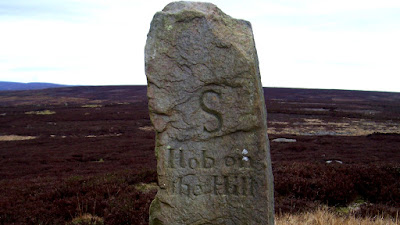
It is believed that the Hobs were remnants of folklore brought to England by the Anglo Saxons and Scandinavians. Burial grounds, barrows and settlement sites across the North East and Anglo-Scottish border were often named after Hobs - to this day these Boundary Marker stones can be found across the North Yorkshire Moors. 


A Boundary Marker stone found on North Yorkshire Moors which has been inscribed as ‘Hob on the Hill’ by Robert Chaloner in 1798


Other places have a direct link to Hobs and Hob related folk tales - usually named as their homes such as the ‘Hob Hole’ caves found along the coast of Runswick Bay and in the cliffs of the North Yorkshire Moors; found on the Yorkshire Moors are the prominent remains of a cairn called ‘Hobthrush Rook’ is said to be the home of a Hob.


Caves in the cliffs of Runswick Bay known as ‘Hob Holes’ due to the belief of Hobs living in them, North Yorkshire, England


The Hob would help a family (usually the family of a farmer or innkeeper) with tasks around the household; they would churn cream into butter, help the farmer thrush wheat or assist the local shopkeeper. They are considered a household spirit similar to Brownies but they are not tied to a particular place but come and go as they please. 


According to traditional folklore Hobs preferred to not be seen and so would come out at night but you may catch them in the corner of your eye before they disappear; Hobs are described as small hairy men with large feet, large ears and long messy hair - also completely naked. Many of the folk tales that include Hobs receiving an item of clothing which they saw as an insult and when offended the Hob would either leave the family or become a boggart and terrorise the family. 


While the Hobs enriched Yorkshire folklore along with the fairies and barghest, although believed to be true over 150 years ago are now a quaint folk tale among old villages; but thankfully not forgotten. 


This is because during the 1800’s a morbid curiosity in the stories of fae and goblin alike began a resurgence; thus it was folklorists who have been able to compile and document these tales that is keeping them alive today for people like myself to discover. 


Research Reference: 

https://mjwayland.com/hobthrush/ 

https://hauntedgeneration.co.uk/2019/09/06/hobnobbing-with-the-hobs/ 

https://www.whitbyonline.co.uk/whitbyhistory/hob.php 

https://www.megalithic.co.uk/article.php?sid=47686 

Encyclopedia of Fairies in World Folklore and Mythology, Theresa Bane, 2013

Folklore of Yorkshire, Kai Roberts, 2013

Beyond Faery: Exploring the World of Mermaids, Kelpies, Goblins and Other Faery Beasts, John T. Kruse, 2020 

Tuesday, February 16, 2021

Semester 2 Project: Compiling Research, Material Culture; Finding Folk tales and Fairy tales in the real world

The term ‘Material Culture’ is what we would refer to these objects as, by definition ‘Material Culture’ refers to an aspect of culture that places importance on the materials, crafting, usage and creation of objects that have a significant importance within traditional customs, stories and rituals - while folk tales have always been an oral tradition in a way these are a companion to folk tales; much like the illustrations in a book they are deeply connected and visually rooted in a culture. 

As a Scandinavian custom a poppet known as ‘The Kitchen Witch’ is placed in the kitchen and is said to bring good luck by warding off evil spirits and preventing your cooking from boiling over or burning.

Similar to the ivory carvings to retell these old stories the characters and creatures of fairy tales and folk tales, the characters from these tales have found their way into the real world. Inspired by stories they have been told, people have recreated and re-imagined the image of these characters and creatures by carving them into the land as if they were always meant to be there.


One of the most prominent examples of this is the depiction of Trolls; across several countries their images have been formed out of stone and many forests, paths, caves and rock formations are named after Trolls such as ‘Trollstigen’,‘Trolltunga’, ‘Trollfjorden’ and ‘Trollskogen’ just to name a few. While some folk tales suggest Trolls where born from stone and when they would rest they return to this form what most folk tales tell us It is believed that when Trolls came out in the sunlight they would turn to stone meaning they could only travel at night; the origins of Trolls are heavily connected to nature, being reclusive they’re always out roaming in the wilderness.


Different troll faces and forms found in the rocks of Sweden, Norway, Finland, Iceland and Denmark

Hvítserkur, also known as the Troll of Northwest Iceland 

Researching this form of material culture I wanted to ask what sort of folklore do we have in England, more specifically in the North? Which is when I came across this stone carving.


Goblin Log, Avenham Park, Preston, Photographed by Claudia Short, 2021

At first glance the figure is rather difficult to see among the foliage, he is a fairly small figure covered in moss and rests by a small wooden bridge that will take you deeper into the Avenham Park woodland. So far I have not been able to collect any information about this stone figure and it leaves me with so many questions such as ‘Who made it?’, ‘Why is it here?’, ‘Why was it made out of stone?’,’What is the folklore behind it?. 


The only sort of information I could find was its name and a brief description -


“Goblin Log, a tree stump shaped stone that has been carved into a goblin”

Goblin Log description, unknown writer 


With the initial aim of this project I wanted to create concept art for a game based on an unknown folk tale so i want to make this goblin stone carving the focus of my research as i believe this could lead me to discovering a fairy tale or folk tale that i can concept into a game.


Research Reference: 

https://www.oxfordbibliographies.com/view/document/obo-9780199766567/obo-9780199766567-0085.xml 

https://www.litcharts.com/how-to-guides/folklore-research-resources 

https://www.encyclopedia.com/social-sciences/applied-and-social-sciences-magazines/ethnology-and-folklore 

https://folklorethursday.com/folktales/brief-history-trolls/ 

https://scandification.com/exploring-the-mystery-of-scandinavian-trolls/ 

https://guidetoiceland.is/history-culture/folklore-in-iceland 

Tuesday, February 2, 2021

Semester 2 Project: Compiling Research about Fairy Tales and Folk Tales

What are folk tales and fairy tales? 

The core of folk tales was to be passed through the oral tradition of telling stories among members of a community; usually within rural areas and small villages in the countryside. 


Unlike fairy tales which are solely fictional, folk tales have a real life belief behind them to the point where festivals are upheld to celebrate the folk tale  and precautions are still practiced to keep creatures from folk tales away from homes; while on the other hand walks, paths and locations are dedicated to finding folk tale creatures. 


Since the early 19th century folk tales have been collected and transcribed into literary form by historians and folklorists within their own country or have gone in search for the folk tales of far off places.The material of folk tales usually consist of warnings to heeded of creatures, spirits or superstitions that inhabit the local areas nearby; whether it’s a fae hound lurking on the moors or wisps luring a weary traveller to a bog to drown.


English rural village

The most famous and most versed line in a fairy tale is ‘Once Upon a Time…’ 


While folk tales and fairy tales may use similar settings and creatures e.g faeries - folk tales have no specific author, fairy tales have altered over time to appeal to younger children with whimsical peril and a happy ending. 


The genre of fairy tales first became popular among French aristocrats and usually read in parlors known as ‘Contes’; this is due to Charles Perrault, known as ‘The Father of the Fairy Tales’ who published in 1697 his book titled ‘Histoires ou contes du temps passé’ which was a collection of tales such as ‘Sleeping Beauty’, ‘Cinderella’, ‘Puss in Boots’, ‘Little Red Riding Hood’ and ‘Bluebeard’.


By laying the foundations of the genre we see 100 years later The Brothers Grimm who collected German fairy tales such as ‘Hansel and Gretel’, ‘Snow White’ and ‘Rapunzel’ just to give a few examples. This in turn influences a variety of authors to collect fairy tales and even create original ones like ‘The Little Mermaid’ by Hans Christian Anderson.  


What makes folk tales and fairy tales so unique and compelling is the visuals that go in hand with the narration of the tale along with a connection to culture and how they can be visually interpreted so differently - as usually so little written detail is given so it is upto the illustrator to create and distinguish this visual interpretation and how it comes to be. 


Many illustrators, animators and artists in general have their own unique visual interpretation of a folk tale or fairy tale that they have brought to life with their work; it is a personal practice backed behind the artists own research, inspirations and art style. Children's book illustrator Arthur Rackham would attribute his succession with illustrating fairy tales from his intimate familiarity with the text. I have been recently reading ‘Arthur Rackham: A Life with Illustration’ and I believe James Hamilton the biographer of the book described Rackham’s role within the Golden Age of Illustration best with this sentence as quoted below. 


“He was – and remains – a soloist in front of an orchestra, a player with the responsibility to interpret and add a personal lustre to great works with variations of infinite subtlety and grace.”

James Hamilton, Arthur Rackham: A Life with Illustration, 2010 


To this day Arthur Rackham’s work inspires illustrators and concept artists like myself which is why my Master is focused on wanting to learn how to process the ideas and stories of others to then transcribe it into artwork that is charming to the point where it is a specialised methodology. 


"She put her arms round the marble figure which was so like the prince"

The Little Mermaid, Hans Christian Anderson, 1837


Illustration of ‘The Little Mermaid’ from ‘Fairy Tales by Hans Andersen,Illustrated by Arthur Rackham’, 

Arthur Rackham, 1932


“They were six beautiful children; but the youngest was the prettiest of them all; her skin was as clear and delicate as a rose-leaf, and her eyes as blue as the deepest sea” 

The Little Mermaid, Hans Christian Anderson, 1837


The Little Mermaid Statue located in Copenhagen, Denmark, by Edvard Eriksen, 1913


Research Reference: 

https://www.masterclass.com/articles/fairy-tales-vs-folktales-whats-the-difference-plus-fairy-tale-writing-prompts#what-is-the-difference-between-fairy-tales-and-folktales 

https://www.britannica.com/topic/folklore-academic-discipline 

https://www.pookpress.co.uk/project/fairy-tales-from-around-the-world/ 

https://thestoryfanatic.blogspot.com/2018/09/how-to-protect-against-fairies.html 

https://www.terriwindling.com/blog/fairy-tales/ 

https://www.illustrationhistory.org/artists/arthur-rackham 

https://blog.bookstellyouwhy.com/celebrating-the-legacy-of-illustrator-arthur-rackham 

https://www.pookpress.co.uk/project/arthur-rackham-biography/ 

Friday, January 29, 2021

Semester 2 Project: An Introduction

For Semester 2 I will be using ‘Idea 2’ from the set of idea drafts I developed at the beginning of Semester 1. 


Idea 2


Look at how concept art depicts both known and unknown folk tales / fairy tales and use this as influence for creating concept art for a video game based on a known or unknown folk tale / fairy tale - possibly interpret it in a way that would suit a video game.


By searching for media that depicts known and unknown folk tales / fairy tales; i will research the history behind these tales so I can analyse how they have been depicted and why they have been depicted in this particular way - is the depiction influenced by imagery we are familiar with?, where has this imagery come from? Has the creator made something new and their own unique take on it and if so why? Is the creator trying to contextualise a different aspect of folk tale / fairy tale? 


I have reflected on what sort of concept artist I want to be and I wish to take the direction of my concept art into defining myself as a concept artist who produces charming 2D art and I will be using this idea to show that. 


During this project I intend to develop a methodology for myself and my style of concept art. I want to identify what makes my concept art the way it is and look at how this could be a pipeline that others who wish to create the same sort of ideas and style of art can follow.


I will need to put myself in the mindset of both a concept artist and game designer; as i will be creating concept art for a video game based on a folk tale or fairy tale i will first need to determine what tale i will be choosing - this will affect what type of genre/platform the game will be along with what concept art i will be creating such as characters, creatures, location, environments, interiors, exteriors and in-game items.


One example of a fairy tale’s visual depiction being changed with concept art is one of my favourite and the first film adaption of the fairy tale ‘Beauty and the Beast’ or in this context ‘La Belle et la Bête’ by French artist Jean Cocteau. 


La Belle et la Bête film screenshots, Jean Cocteau, 1946


The story of beauty and the beast exists in a variation of ways- collected by folklorists across the world, each country having in some way it’s own version of the fairy tale. The version we know was written and published in 1756 by french author Jeanne-Marie Leprince de Beaumont  which in itself was adapted from an earlier version of the story published in 1740 by french author Gabrielle-Suzanne Barbot de Villeneuve. Beaumont kept many aspects of the original story the same but with some alterations by cutting out subplots and characters she rewrote the lengthy story to be more suitable for children. 


In many early illustrative renditions of the fairy tale the beast is often designed as an elegantly  dressed boar-like creature, the earliest iteration of this design I could find was by the prolific  illustrator Walter Crane; I found this interesting as it differs so greatly from the design we are familiar with. 


Beauty and the Beast, Walter Crane, 1874

Beauty and the Beast, Peter G. Thomson, 1885 

Beauty and the Beast, Warwick Goble, 1913


In both Villeneuve and Beaumont’s versions of the tale there is no distinct description of what the beast looks like besides ‘frightening’ ‘hideous’ and ‘monstrous’- with a particular emphasis on the beast's stupidity and boorish behaviour, this is due to the french definition of ‘beast’ meaning both a large creature/animal and someone who is foolish/stupid. 


“So I am,” said the monster, “but then, besides my ugliness, I have no sense; I know very well, that I am a poor, silly, stupid creature.”

La Belle et la Bête, Jeanne-Marie Leprince de Beaumont, 1756 


Walter Crane’s art popularised and redefined the idea of visual literacy for children by improving the standard of ‘Toy Books’ - children's picture books that were produced during the victorian era; they featured nursery rhymes, fairy tales and other stories. With so much freedom of creativity for an illustrator to design the beast as they please it is uncertain why Walter Crane designed the beast as a boar; it could be that a the image of a boar contrasted so heavily with his beautifully detailed and decorative art style or it is believed when planning and creating his illustrations that he would spend his time considering the perspective of a child so perhaps a large, hairy, tusked boar would be considered a scary and ugly monster to a child. 


Unlike these earlier renditions of the beast Jean Cocteau’s 1946 film took the design in a different direction by making the beast more lion like as Cocteau wanted to evoke both fear and sympathy; one of the earliest ideas was for the beast to have a stag head however this was scrapped as it was too similar to the Cernunnos, the Celtic stag-headed god of the woods. 


Film poster for Jean Cocteau’s ‘La Belle et la Bête’, illustrated by Jean-Denis Malcles, 1946

‘La Belle et la Bête’ film poster and ilm poster initial sketch, illustrated by Jean-Denis Malcles, 1945


"My aim was to make the Beast so human, so superior to men, that his transformation into Prince Charming would come as a terrible blow to Beauty, condemning her to a humdrum marriage and future; it would expose the naivete of the old fairy tale that conventional good looks are ideal".

Jean Cocteau, Press book for US premier of ‘La Belle et la Bête’, 1947


As a surrealist artist Jean Cocteau re-invented ‘La Belle et la Bête’ by changing aspects of the story; adding magic mirrors and living statues he created a fanciful black and white film that turned the beast's castle into a realm outside of reality with the use of long dark halls lit by candle light and diamond tears to create haunting, dream-esque scenes - we can see these sort of visuals being conveyed in Christian Bérard’s concept art. 


Concept art of costumes and sets for Jean Cocteau’s ‘La Belle et la Bête’, Christian Bérard, 1946

Cocteau In a similar fashion to Walter Crane wanted to convey the perspective of children - so much so that when opening the film he asks his audience to suspend disbelief in the same way a child would when listening to a fairy tale.


“Children believe what we tell them. They have complete faith in us. They believe that a rose plucked from a garden can plunge a family into conflict. They believe that the hands of a human beast will smoke when he slays a victim, and that this will cause him shame when a young maiden takes up residence in his home. 


They believe a thousand other simple things. I ask of you a little of this childlike sympathy and, to bring us luck, let me speak four truly magic words, childhood’s “Open Sesame”: 


Once upon a time…”

Jean Cocteau, opening credits of ‘La Belle et la Bête’, 1946


Jean Cocteau’s iteration of the fairy tale still remains the most visually influential and we can even see this influence in the concept art and visual direction of Disney’s 1991 animated film.


Beauty and the Beast concept art, Andreas Deja, Disney, 1991

Research Reference: